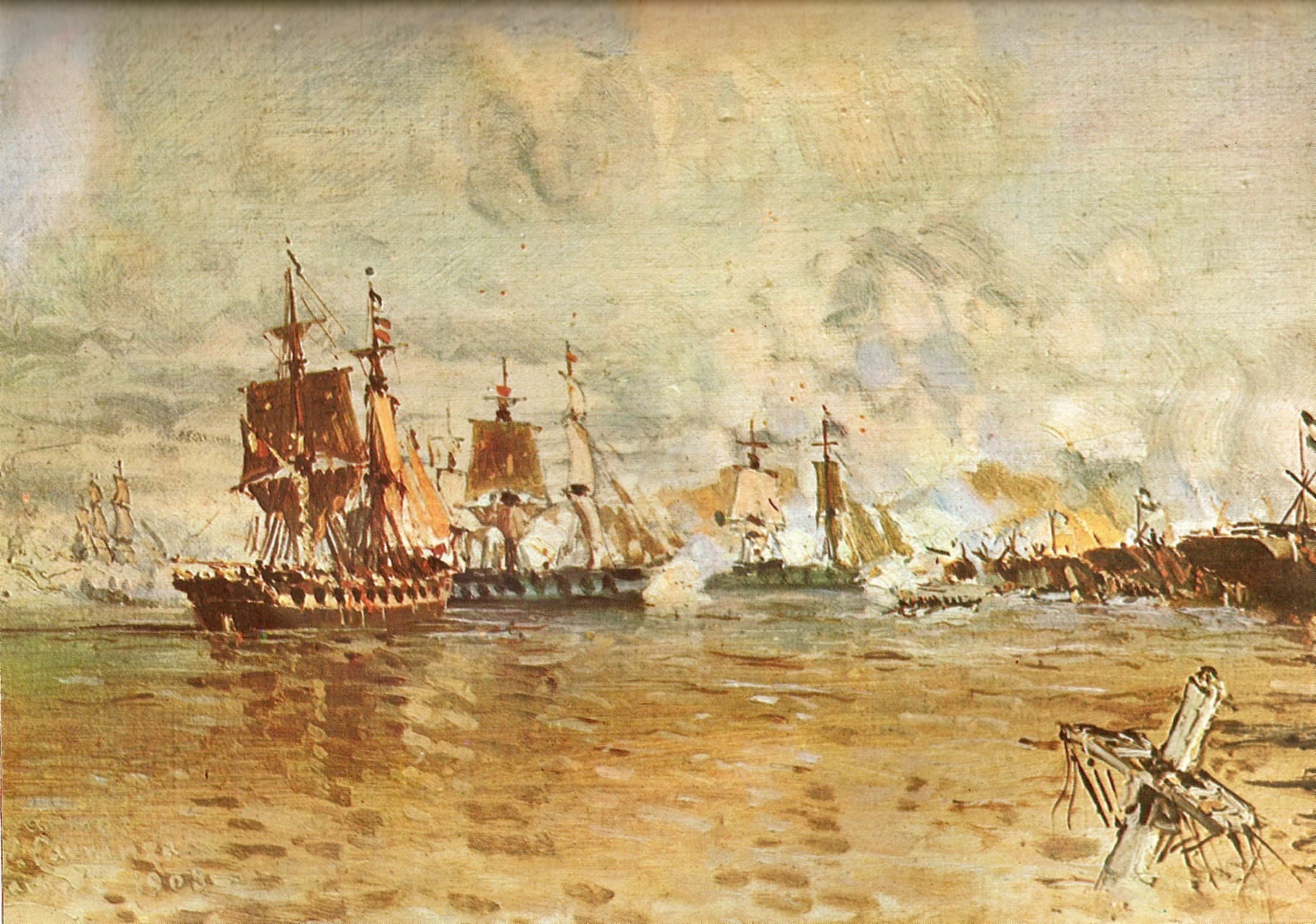
On a tight bend of the Paraná River in the Buenos Aires district of San Pedro, Argentine troops once stretched heavy chains across the water, planted cannon batteries along the cliffs, and braced for a naval force that dwarfed them in firepower and numbers. The battle that followed on November 20, 1845 — the Battle of Vuelta de Obligado — lasted more than seven hours. The Argentine Confederation's forces, numerically inferior and less equipped, managed to obstruct the fleet's passage and prevent a clean consolidation of the invaders' objectives.
A Battle That Grew in Meaning Over Time
The episode unfolded during a period when European powers were actively probing the political edges of a newly independent South America. An Anglo-French fleet moved up the Paraná with the stated intention of opening river trade routes and expanding commercial influence. From Buenos Aires' perspective, this was not commerce — it was an attempt to colonize markets and override Argentine control over its own interior waterways.
The chain-and-cannon defensive strategy managed to obstruct the fleet's passage long enough to deny the invaders a clean consolidation of their objectives. The foreign fleet eventually pressed through, but the broader campaign failed to achieve its political aims. Hostilities eventually concluded with a treaty that formally recognized Argentina's sovereign rights over its interior rivers — a diplomatic outcome that, in retrospect, validated the military resistance.
For nearly 130 years, the battle remained a point of historical pride without official civic status. That changed in 1974, when November 20 was formally declared Día de la Soberanía Nacional — National Sovereignty Day — elevating the engagement from historical footnote to anchor of the national calendar.
Sovereignty as a Multi-Layered Concept
What makes the Argentine framing of Vuelta de Obligado particularly instructive is how broadly the state defines what was actually being defended that day. Official commemorations, including those issued from the Casa Rosada, frame the battle not merely as a defense of riverbank territory but as a defense of political independence, economic self-determination, and cultural autonomy simultaneously.
This expansive reading of sovereignty reflects a tension that runs through much of post-colonial South America. Independence from European crowns in the 19th century did not automatically translate into freedom from European — or later, North American — economic and political pressure. For many South American nations, the post-colonial era has involved a second, subtler struggle: asserting control over natural resources, trade terms, and internal governance against the influence of powers that never formally colonized them but shaped their conditions nonetheless.
Argentina's invocation of Vuelta de Obligado speaks directly to that tension. The battle is remembered not as a desperate defense against a traditional invading army but as a resistance to commercial imperialism — a distinction that resonates across generations and political contexts.
Territory Without Borders: The Antarctic Dimension
The geographic scope of Argentina's sovereignty claim extends well beyond the Paraná. Official commemorations explicitly invoke Argentine presence from the country's northernmost point to Base Marambio in Antarctica — a deliberate rhetorical gesture that frames sovereignty as a continuum rather than a fixed line on a map.
Argentina is among the nations that maintain active territorial claims in Antarctica, and the inclusion of Marambio in sovereignty discourse reflects how deeply that claim is embedded in national identity. Whether in river battles of the 1840s or polar research stations of the 20th century, the narrative thread is consistent: Argentine sovereignty is something actively maintained, not passively inherited.
Memory, Resistance, and Democratic Values
Across South America, the construction of national identity through military memory follows a recognizable structure. A foundational moment of resistance — often against a technologically superior external force — is selected, institutionalized through a public holiday or monument, and then reinterpreted across successive political generations to serve contemporary purposes.
What distinguishes the Argentine case is how explicitly the resistance narrative is tied to democratic and civic values rather than military glory alone. The soldiers at Vuelta de Obligado are commemorated not primarily as warriors but as defenders of a collective right — the right of a people to govern their own rivers, resources, and future. That framing allows the anniversary to function across the political spectrum, invoked by governments of markedly different ideological orientations.
The battle also carries a social dimension that keeps it relevant beyond ceremonial dates. Vuelta de Obligado has come to represent the proposition that numerical and material inferiority does not determine political outcome — that organization, determination, and legitimacy can offset raw power. For a continent that has long negotiated asymmetric relationships with wealthier nations, that proposition carries persistent appeal.
Remaining Questions
Several aspects of this topic warrant further reporting and cannot be addressed from currently verified sources. The precise nature and terms of the peace treaty that followed the Anglo-French campaign — including which parties signed it and when — require documentary verification beyond what is available here. The specific political context in Argentina in 1974 that prompted the formal declaration of National Sovereignty Day merits deeper examination, as the choice of that particular moment was unlikely to be politically neutral. The degree to which different Argentine governments have used or downplayed the commemoration for contemporary political purposes is also underexplored. Finally, how other South American nations construct analogous sovereignty narratives around comparable historical episodes — and whether regional bodies like UNASUR or CELAC have sought to build shared commemorative frameworks — remains an open comparative question.
Source: Argentine Government
This article was compiled with the support of advanced research technology, based on multiple verified sources, and reviewed by our editorial team.